
Foundation piering in Kansas City runs $1,200–$3,000 per steel pier, with most settlement jobs at $4,000–$15,000 for three to eight piers. Piers transfer the house's load below the Wymore-Ladoga clay — USDA-rated “very high” shrink-swell — onto strata that hold still.
Why KC footings settle, what a pier changes permanently, and how the count and price get set.
Settlement, the KC edition
A footing on very-high-rated clay rides an annual elevator: saturated swell in spring, hard contraction in late summer, a hundred freeze-thaw jolts through winter. Most houses ride it gracefully for years — then a dry cycle overshoots, support goes missing under a corner, and the masonry starts writing memos: stair-steps over the garage, a hairline at the kitchen window, the front door demanding a shoulder. Older Northland and Raytown ranches do it from age; newer Lee's Summit builds do it where fill met cut. The mechanism is identical — soil quit — and cosmetics can't rehire it.
What steel changes
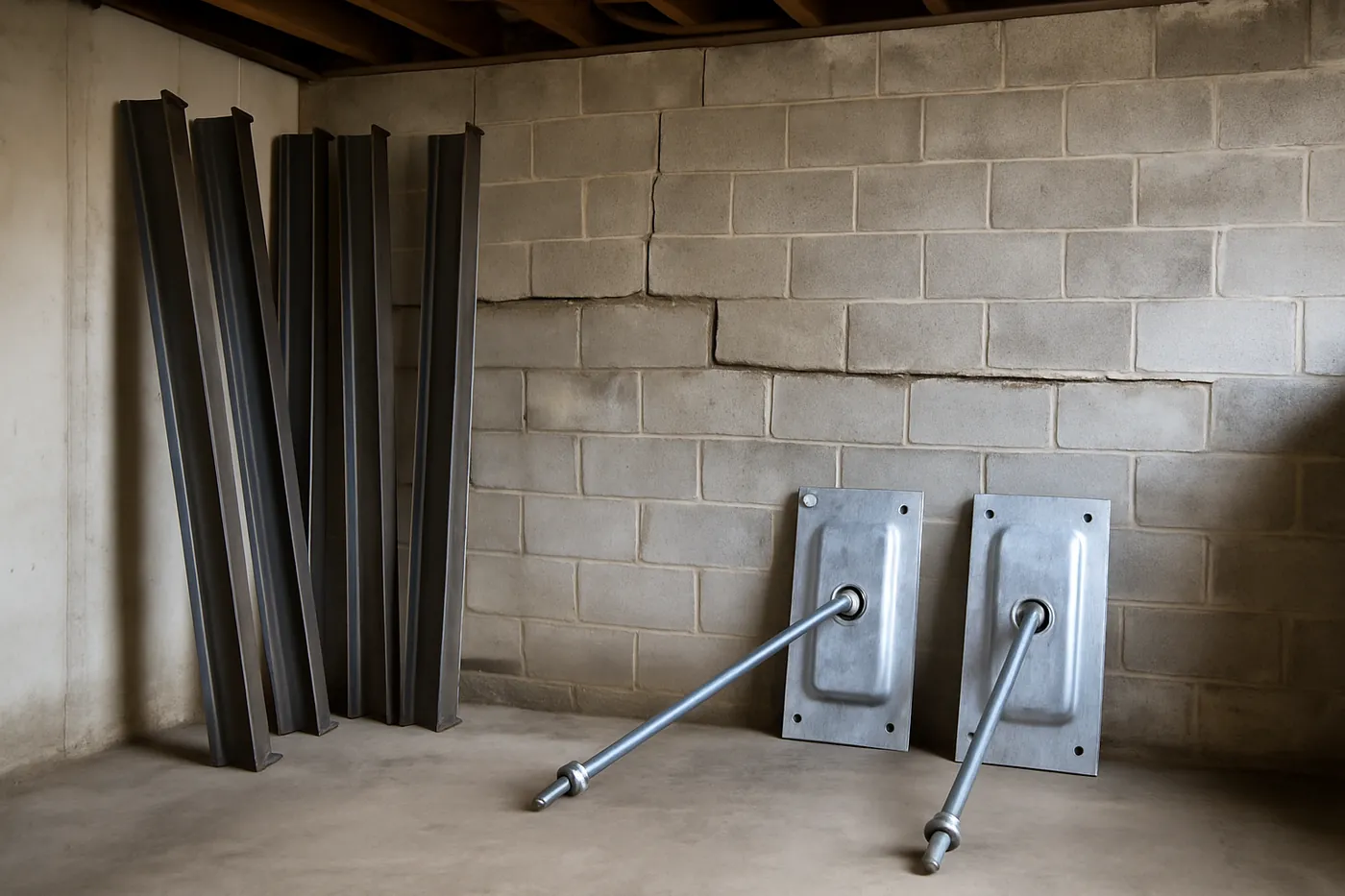
A pier is a bypass: driven section by section to refusal, bracketed to the footing, loaded by hydraulics. From then on the rated clay is just weather — it can swell against the pier shafts all it wants; the house's weight rests on strata beneath the whole argument. In much of the metro, drives find genuine confidence when they reach the region's limestone-shale benches: refusal you can feel in the gauge readings.
| System | How it reaches refusal | KC fit |
|---|---|---|
| Push piers | Hydraulic press against structure weight | Brick, stone veneer, the metro's heavier stock |
| Helical piers | Screwed to verified torque | Frame builds, additions, porches, deck-to-structure ties |
Piering inside the whole repair
The clay that dropped your footing spent the previous wet season pushing your walls — KC failures come in sets. The evaluation reads the set: laser levels for settlement's footprint, deflection gauges on every basement wall, crack map, water walk. If the honest scope is piers plus restraint, or piers after drainage stops feeding the cycle, it's written that way — sequenced so the fixes protect each other and priced line by line.
What moves the number
- Run length — piers at 5–8 foot centers along affected footing
- Depth to refusal — deeper fill or missing rock bench means more feet
- Access — open yard runs vs. interior slab pits vs. landscaping to save
- Lift ambition — recovering elevation costs more time than locking in place
Movement that's already finished gets a monitoring plan instead of steel — the dated baseline makes that answer defensible, and it costs nothing.
Piering the metro's 60-80% clay: depth beats hope
The Wymore-Ladoga complex under Kansas City runs 60 to 80 percent clay with a USDA "very high" shrink-swell rating — soil that doesn't merely move, but moves with authority, loading and unloading footings through more than a hundred freeze-thaw cycles a year. Piering here is an exercise in getting below all of it: brackets bolted to the footing, steel driven hydraulically to refusal, and the pressure at refusal logged per pier as proof the column reached strata indifferent to whatever the clay does next. The 36-inch code frost line is a starting point the piers pass on the way down, not a destination.
Installs run two days to a week, houses stay lived-in, and lift is synchronized and monitored against interior crack widths. One KC-specific honesty: on clay this active, we schedule final lift readings against the season — a house lifted to level in saturated April sits differently in baked August, and a pier plan that ignores that is a callback plan.
Piering questions, straight answers
How deep do piers go under a Kansas City house?
Code worries about 36 inches of frost; piers ignore that number and drive until refusal at load-bearing strata — through the full Wymore-Ladoga profile and any fill, commonly 12 to 25 feet. In parts of the metro that's helped by shallow limestone and shale benches that give piers a decisive stop.
What does piering cost in KC?
$1,200-$3,000 per pier installed, three to eight piers on most settled runs, so complete jobs mostly land at $4,000-$15,000 inside the Missouri structural band of $3,800-$12,500. The pier count comes from a laser survey, not a windshield estimate.
Push piers or helicals for my house?
The structure picks: push piers use building weight to reach refusal and favor the metro's heavier brick and stone-veneer stock; helicals torque in and carry lighter frame homes, porches, and additions cleanly. Both end the clay's vote in your elevation.
Can you lift the house back level?
Often — the same hydraulics that load the piers can walk a settled section back toward original elevation, closing cracks as it travels. Where finishes or brittle plaster argue for caution, we stabilize in place and write exactly that. Goal stated first, in the scope.
Does drought settlement come back after piering?
Not through the piers — that's the point. Once load rests on deep strata, the surface clay can shrink through the driest August it likes; your footing no longer subscribes to its moods. The warranty carries that promise in writing.
Get a free Kansas City foundation evaluation
Tell us what the house is doing — cracks, a leaning wall, doors gone crooked, water in the basement — and we'll schedule an evaluation with photos and crack measurements. We reply the same business day.